Planning a long holiday in Mallorca? Not every traveller arrives in Mallorca with a packed itinerary of coastal roads, hidden coves, and villages to tick off a list. The frantic “country counting” that Instagram made fashionable has had its day, and more and more visitors are choosing the island for exactly the opposite reason: to slow down, stay longer, and actually live it. Whether that means combining work and holiday, or simply spending one or two weeks taking Mallorca at their own pace.
On a longer stay like this, getting around tends to look quite different from a long weekend or a short break. Beyond the transfer to and from Palma Airport, the odd excursion from the hotel, a change of accommodation, or a special dinner at a particular restaurant, there’s often no real need to be on the road every day.
With more time on your hands, it becomes much easier to spend whole days at the hotel, walk down to the nearest beach, and eat locally. The island lends itself beautifully to this kind of trip — the art of dolce far niente, doing nothing in particular and doing it well.
Take Port de Pollença as a prime example. You could easily spend several days moving between the seafront promenade, the beach, the harbour, and the restaurants nearby without needing a vehicle at all. For most visitors staying here, the journeys that actually require transport tend to come down to the airport transfer, a day out in the Serra de Tramuntana, and an afternoon in Palma to explore the old town and do a bit of shopping.
On a trip like this — one built around rest and simplicity — having a hire car sitting in the car park for four or five days running adds very little value. What matters is being able to handle those specific journeys where distance, timing, or luggage actually makes a difference. A private transfer is often the most sensible solution for exactly those moments.
If, on the other hand, you’re the kind of traveller who wants to explore the island thoroughly, then transport needs to be properly thought through — and a hire car may well be the right answer. Either way, before booking anything, the key is being honest with yourself about how you actually want to spend your holiday.
Will you really use a car every day?
In our experience as a VTC operator in Mallorca, the question worth asking before you book anything is: how many days will you genuinely need a vehicle? Because, as we’ve seen, even if a hire car is the first thing that comes to mind, if you’re only planning three or four journeys over a ten-day stay, it simply won’t be worth it. And hiring one for just four days means cramming all your excursions into that window — which takes away the flexibility and spontaneity that a longer holiday is supposed to offer.
So, from our perspective — having seen how travellers actually move around the island — if you’re staying for more than seven days in Mallorca, plan your trip before you plan your transport. Think about which excursions you’d like to do, which routes you want to explore, which places you’d like to visit.
Your accommodation also makes a significant difference. Staying in a village in the interior — somewhere like Artà — is a very different proposition from basing yourself in a busy tourist area such as Playa de Palma, which sits just a short distance from both the airport and the centre of Palma, with a long sandy beach on the doorstep and plenty of restaurants, theme parks, sports facilities, bars, and nightlife all within easy reach.
With car hire prices in Mallorca continuing to rise, the goal is to make the most of every day you have a vehicle. If you’re staying for ten days or more, make sure the car won’t end up sitting outside your hotel for the best part of the trip.
Transport for every day
For stays of one to two weeks or more, a hire car tends to make most sense if you plan to be on the move most days:
- If you want to explore a different part of Mallorca almost every day
- If you’re staying in a rural property or finca away from any town or village
- If you prefer to be completely spontaneous with your routes and timings
- If your accommodation has easy, hassle-free parking
Transport for specific journeys
When your need for transport is more occasional, combining public transport with a private transfer can be a much more comfortable alternative — and sometimes a more cost-effective one too.
A taxi or private chauffeured transfer tends to be the most practical option when travelling with a lot of luggage — or specialist kit such as bikes — and equally when travelling as a family or group, since it allows you to plan timings, pickup points, and vehicles around each specific journey.
At Salty Driver, this kind of on-demand transfer is very much our speciality. Some clients only need us twice — arriving and leaving. Others get in touch to reach a specific restaurant in a quieter part of the island, such as the Serra de Tramuntana, or to connect a day out on the water with their hotel. These aren’t travellers who want a car every day — their holiday in Mallorca is about relaxing, and they simply want the journeys that matter to be properly sorted.
A straightforward way to think it through is to treat the trip like a rough diary:
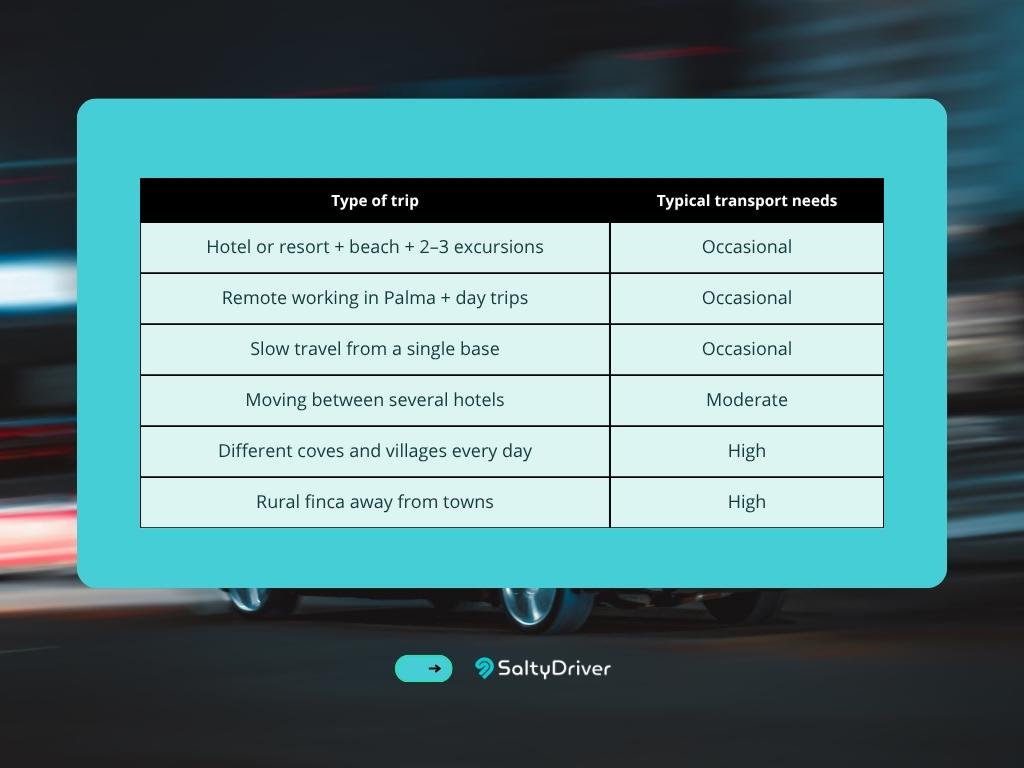
When a private transfer really comes into its own
Every trip is different, but there are certain journeys during a one or two-week stay where a private chauffeured transfer is noticeably more convenient — particularly if you’d rather not drive. You’ll save yourself the frustration of arguing with Google Maps, hunting for parking, and navigating unfamiliar roads in areas you don’t know.
As a Mallorcan company, we know the island well — and we know that getting around Mallorca isn’t always straightforward (and is becoming less so every year). That’s why we generally recommend looking at each journey individually. Some can be handled perfectly well by public transport; others are where having a driver makes all the difference.
Here are some of the journeys our clients most commonly request during longer stays:
-
Airport arrivals and departures
As an island, most long stays begin and end at Palma de Mallorca Airport — or occasionally the port. The transfer between the airport and your accommodation, and back again at the end, is one of the few journeys that’s simply unavoidable.
Airport transfers need to be arranged in advance, particularly when travelling as a group — whether with family or friends — and whenever there’s bulky luggage involved: multiple suitcases, golf clubs, bikes, or professional equipment.
It’s also worth sorting this out early if your accommodation isn’t in Palma or a nearby area such as Calvià or Llucmajor. If you’re staying somewhere like Port d’Alcúdia, Port de Sóller, Cala d’Or, or Port de Pollença, you’re looking at roughly an hour’s journey — which you can cover by taxi or VTC. It’s worth comparing distance, price, flexibility, and what each option actually offers before deciding.
Our advice is to keep it simple. Especially after a long flight, arriving late, with children and several bags in tow, having a professional driver waiting for you — ready to help and take you straight to your home for the next week or two — is one of the best ways to start a holiday.
-
Transfers between hotels
A longer stay also opens up the possibility of discovering Mallorca from more than one base — and it’s a genuinely interesting way to travel, since each part of the island has its own distinct character. The large beachfront resorts of somewhere like Playa de Muro, complete with beach clubs, are a world away from the boutique hotels of central Palma that invite you to experience the city like a local.
One itinerary we see fairly often is families who want to spend the first part of their holiday unwinding at a resort — in Colònia de Sant Jordi, Port d’Alcúdia, or Sa Coma, say — before saving the final few days for Palma and its lively Mediterranean atmosphere.
In these cases, a private transfer takes care of moving all the luggage between hotels comfortably, without the need to return to the airport, hire a car just for that leg, or piece together a series of connections.
-
The must-sees in Mallorca
When planning a one or two-week holiday in Mallorca, there are likely a handful of iconic places you’ll want to include, even if most of your trip is centred around rest, remote work, or simply enjoying the area around your hotel.
Many of these highlights get busy — and on certain days, particularly in high season, traffic, access, and parking can become a real headache. Try not to let it get to you: you’re on holiday, after all. But if you’d rather sidestep the stress, a private transfer is a very practical way to cut out much of that logistical noise and focus on actually enjoying the day.
Some of the most frequently requested destinations among our clients include:
Puerto Portals — a perfect afternoon spent strolling around the marina, browsing the boutiques, and finishing with dinner by the water. One of those corners of the island where luxury feels entirely at home.
A route around the north of Mallorca — taking in the historic town of Alcúdia, Port d’Alcúdia, and Playa de Muro, consistently ranked among the world’s top twenty beaches.
Formentor — worth a mention of its own, even within that northern route. Road access to the peninsula is regulated during the busiest months, and conditions can vary depending on the time of year and the specific stretch of road. If you want to include the peninsula or the lighthouse in your plans, we’d always recommend checking the current regulations and planning the route before you set off, rather than assuming all vehicles can access every point.
Coves del Drach or Coves dels Hams — both in Porto Cristo, and both classic excursions on the east coast of the island. Particularly worthwhile on a first visit to Mallorca, or if you’re travelling with young children — they’ll be genuinely amazed.
Es Trenc — Mallorca’s great southern beach, and one that feels almost Caribbean: crystal-clear water, fine white sand, and a laid-back atmosphere that’s hard to leave behind. Not just a one-off experience — most people who go once find themselves going back.
Deià — a beautiful village tucked into the hillside of the Serra de Tramuntana, looking out over the Mediterranean. Long a favourite of artists, writers, slow travellers, and a certain kind of well-travelled visitor who knows a special place when they find one.
Singular experiences for a long holiday in Mallorca
Beyond the classic sights, a stay of one or two weeks gives you the breathing room to include experiences that simply don’t fit into a short break. Here’s a small selection of the experiences for which our clients most often book a private transfer:
A special dinner
One such experience might be an evening at one of Mallorca’s Michelin-starred restaurants or most celebrated dining destinations — DINS Santi Taura in Palma, Oliu near Port d’Andratx, Maca de Castro in Port d’Alcúdia, along with other acclaimed spots dotted across the island that offer a genuinely different way to discover Mallorca through its food.
A particularly special example is Ca Na Toneta — tucked away in the village of Caimari, well off the usual tourist trail. A restaurant where seasonal, organic, deeply rooted Mallorcan cooking takes centre stage, served in a traditional house with a vine-covered terrace and an interior dining room that feels as authentic as the island gets.
A boat trip
Heading out onto the water has become something of a must-do in Mallorca over recent years. Trips depart from various ports with certified local operators, many of whom offer the option of a llaüt — the traditional wooden boat of the Balearic Islands, now updated with an electric motor, which makes the experience feel even more special, and considerably kinder to the environment.
Our clients typically book a transfer from their hotel to the port before departure. The transfer then returns at an agreed time to bring them back. That time is always confirmed individually, since some clients prefer to be collected straight after the boat trip, while many others choose to stay on for lunch or dinner at the port and return later in the evening.
Golf and sport
There’s plenty on offer for sport-minded visitors during a longer stay in Mallorca. If that’s you, the first thing to consider is whether you’ll be bringing your own equipment — bikes, golf clubs — as this has a direct impact on how you get around.
If you’re travelling with specialist or bulky kit, a private transfer is strongly recommended: it’s a far more comfortable, flexible, and personalised option, and can be adjusted to fit around whatever you have planned each day.
One of the most common examples is transfers to and from Mallorca’s golf courses — Club de Golf Alcanada, Golf de Andratx, Golf Son Vida, and others. Another is cycling groups who plan a different route each day and need a support vehicle both for carrying equipment and for stepping in if any member of the group needs assistance.
Days out with children
Family trips to Mallorca with a longer stay also allow you to set aside a day or two for theme parks and family-friendly activities. The long-established favourites are Aqualand El Arenal, in the s’Arenal/Llucmajor area, and Katmandu Park on the Calvià coast. Both are reachable by public transport — urban and inter-urban buses — or you can simply keep things straightforward and book a private transfer or taxi.
For all of these, it’s worth arranging transport in advance so you can make the most of the day and return to your accommodation without any last-minute scramble.
Local knowledge matters
One final thing worth keeping in mind: in Mallorca, the experience varies enormously depending on where you’re based. A week in central Palma has entirely different transport needs from seven days at a rural finca in the Pla de Mallorca. A villa in Santanyí is a different world from a hotel on the Port de Pollença seafront.
That’s where local knowledge really matters. At Salty Driver, our job isn’t simply to send a vehicle. When a traveller tells us where they’re staying, which days they have plans, and what they’d like to see, we can help them work out which transfers they actually need — and avoid the ones that won’t add anything to their trip.
Still not sure how to plan your transport for a one or two-week stay in Mallorca? Get in touch with our team and tell us where you’re staying and what you have in mind. We’ll help you work out the most comfortable and logical approach for your trip — without booking a single journey more than you actually need.