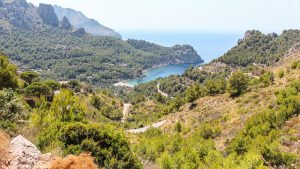
When autumn arrives, Mallorca shifts — and so do the plans. The island quietens down, temperatures ease, and a different kind of energy takes over: the desire to do things differently. Autumn in Mallorca is the season for more authentic experiences, beyond the beach: mountain routes, visits to local wineries, and finally exploring those places you deliberately steered clear of in the height of summer.
By October, the inland roads have recovered their calm. The Tramuntana beckons walkers again, and in villages like Binissalem, Inca, and Caimari the calendar revolves once more around wine, traditional fairs, and seasonal produce.
Contrary to what many might expect, autumn isn’t simply a quieter version of the Mallorcan summer. It’s an entirely different way of experiencing the island. A morning among the vineyards in the Raiguer, sharing a table at an inland celler, and — to round off the day — a picnic at sunset on Sa Foradada (mercifully free of summer crowds), after a walk through the Serra de Tramuntana.
The thing is, autumn days are shorter. Some mountain routes end far from where they began, and the big traditional fairs temporarily transform the traffic in usually peaceful villages… So it pays to plan your journeys a little more carefully.
At Salty Driver, we spend a good part of the year travelling these roads — and there are routes and experiences that in autumn we particularly recommend to those who want to discover the real Mallorca. These are our favourites.
Mallorca in Autumn: What’s Worth Doing
Autumn is one of the best times of year to explore the Mallorcan interior and the Serra de Tramuntana. Between September and November you can combine winery visits, hiking, seasonal gastronomy, weekly markets, and some of the island’s most important traditional fairs. With significantly less tourist pressure than at the height of summer, it’s also far more enjoyable to string together several villages or experiences in a single day.
Visiting Mallorca’s Wineries
Mallorca has a deep-rooted winemaking tradition. The island is home to over 70 wineries and two of its own designations of origin — DO Binissalem and DO Pla i Llevant. If you’re a wine lover, autumn offers a wonderful opportunity to spend a day among barrels and native grape varieties.
The Great Binissalem Festival
Where to begin? A perennially popular choice is visiting the wineries of Binissalem — Mallorca’s wine-producing heartland par excellence. And if your trip coincides with the very end of summer, there’s one event that absolutely deserves a place in your diary: the Festa des Vermar, which celebrates the end of the harvest season and the island’s change of pace.
For almost the entire month of September, Binissalem — nestled at the foot of the Serra Tramuntana — hosts a packed programme of activities centred around the grape and the vine. From the entertaining boot races of the first weekend, through the traditional grape-throwing battle, the popular harvest lunch of fideus de vermar, and the grape-treading competition of the second weekend — and, of course, the magnificent float parade and the Fira del Vi on the third weekend, where you can taste the prized wines of the DO Binissalem.
Getting to Binissalem
If you’re setting off from Palma, you can make a first stop in Santa María del Camí and Consell — whose wines fall under the DO Binissalem appellation — with highly regarded native varieties such as Manto Negro (reds) or Moll/Premsal Blanc (whites). You’ll also enjoy their historic streets, charming squares, and a genuine taste of inland Mallorca.
Our recommendation: at the heart of the Raiguer wine country, you can link Santa María del Camí, Consell, and Binissalem — a succession of villages historically tied to viticulture. If you’re specifically seeking DO Binissalem wines, look out for acclaimed wineries such as José L. Ferrer in Binissalem or Jaume de Puntiró in Santa María del Camí.
The Pla de Llevant
Another wonderful option is exploring the DO Pla i Llevant area, which also opens the door to Mallorca’s most rural heartland. Here you’ll find benchmark wineries such as Vins Miquel Gelabert (Manacor), Miquel Oliver (Petra), or Armero Adrover i Vinicultors (Felanitx). The perfect place to discover native varieties like Callet, Gorgollassa, Premsal Blanc, or Giró Ros — some of which are in the process of being revived.
And why not make the most of the journey to discover other corners of the area? You could visit the birthplace of Fra Juniper Serra in Petra, stop at the Rafa Nadal Museum in Manacor, or climb up to the Santuario de Sant Salvador in Felanitx, where the views of Mallorca will stay with you long afterwards.
Our recommendation: it’s worth bearing in mind that a wine-tasting itinerary and getting behind the wheel simply don’t mix. When planning your days on the island, remember to book your transport for these visits in advance. Opting for a chauffeur-driven vehicle means you and your companions can enjoy the full experience without any concern about driving — and even consider a more ambitious programme, visiting several wineries in a single day.
Hiking in the Serra de Tramuntana
As summer draws to a close, mountain walks through the Serra de Tramuntana become one of the truly unmissable autumn activities in Mallorca. With cooler temperatures, exploring the island’s natural beauty is far more comfortable.
The Serra Tramuntana — a UNESCO World Heritage Site — offers a wide variety of routes for discovering its landscapes and heritage. The Consell de Mallorca maps out, for example, 20 cultural hiking routes, one for each municipality of the Serra Tramuntana — from the walk from S’Arracó to La Trapa, through ancient pathways and mountain scenery, to the itinerary from Deià to Cala Deià and the Torre de sa Pedrissa, which weaves together village and coastline.
There are options for every taste and ability level, including popular circular routes such as the walk from Valldemossa around the Camí de S’Arxiduc, with sweeping views of the Mediterranean.
But there are also point-to-point routes connecting different parts of the Serra, such as the GR-221 section between Deià and Sóller, the stretch from the Cúber reservoir to Sóller via the dramatic Barranc de Biniaraix gorge, or the classic village-to-village walk from Esporles to Valldemossa.
Before heading out into the Tramuntana, a few things worth keeping in mind: autumn brings more comfortable temperatures, but also progressively shorter days and occasional spells of heavy rain. Before any route, it’s worth checking the weather forecast, the condition of the path, and its realistic difficulty — and making sure you have appropriate footwear, water, and enough time to finish before dark. In protected natural areas, always follow the signage and any access restrictions in force.
One more practical detail worth planning for: not all of the Tramuntana’s most beautiful routes are circular. On point-to-point itineraries — such as certain sections of the GR 221 — it’s far more comfortable to agree in advance where the walk starts and where you’ll be collected at the end. This is something we always take particular care of when organising transfers for hikers.
Hiking in the North of Mallorca
Beyond the Serra Tramuntana, Mallorca has more to offer walkers in autumn. Less well-known routes with equally breathtaking views.
In Alcúdia, one of the most popular is the walk from the Ermita de la Victòria up to the Talaia d’Alcúdia, with panoramic views over the bay of Pollença and Cap de Formentor.
Further east, the Parc Natural de la Península de Llevant, near Artà, offers over 30 walking routes — between the hills of Artà and coastal trails such as the path from Betlem to the Caló de Ferrutx.
From Betlem you can also discover other hidden gems such as S’Aigua Dolça or Na Clara — a small, crystal-clear cove tucked between pine trees and rocks, looking out over the bay of Alcúdia. It’s well worth stopping at the small coastal village of Colònia de Sant Pere to recharge by the sea.
Worth bearing in mind… Whatever route you choose, remember that in autumn there are fewer hours of daylight — so allow yourself plenty of time before dark when planning the route and setting your pick-up time. If you need guidance, at Salty Driver (Carrer Ca Na Melis, 10, Llevant, 07007 Palma, Illes Balears) we can help you plan the logistics.
A Gastronomic Tour of Mallorca
September, October, and November are synonymous with Mallorca for food lovers. It’s the perfect time to organise a trip built around discovering the island’s quintessential autumn cuisine.
The lighter summer dishes and the classic trampó salad give way to hearty, warming plates: the celebrated arròs brut, traditional recipes featuring mushrooms such as gírgoles (oyster mushrooms) and the prized esclatasangs (a type of wild milk cap), the classics of matances — Mallorca’s traditional seasonal preparation of pork: sobrassada, botifarrons, llom amb col… — and a wealth of other seasonal produce.
Our favourite dishes of the season? Without question, the sopas mallorquines — paper-thin slices of bread slowly cooked with vegetables, a recipe that varies subtly from household to household. Don’t miss the frit de matances either, the classic ensaïmada filled with cabell d’àngel, or the bunyols (a type of fritter) that are a hallmark of autumn, traditionally made for the festivities of Ses Verges.
A Gastronomic Day Out in Palma
A perfect excuse for a culinary exploration of Palma’s restaurants. If you want to experience Mallorca’s most traditional cooking, the options are excellent. Among the great classics: Celler Sa Premsa, open since 1958 and with its great wine barrels as its most iconic feature, and Celler Pages, in the La Lonja neighbourhood — a family-run restaurant with a wonderfully rustic atmosphere. Both are ideal for dishes like arròs brut, tumbet, or frit mallorquí.
Before sitting down to eat, it’s well worth a visit to the Mercat de l’Olivar — one of Palma’s most emblematic covered markets — to immerse yourself in the aromas and flavours of traditional Mallorcan cooking.
Do not forget to… book in advance, particularly at weekends. Palma in autumn is quieter, but it remains a lively city. And if you want to make the most of your day without worrying about parking or missing any of its highlights, a private chauffeur service is an excellent option.
Gastronomy in the Inland Villages
To truly experience it, you need to venture out into the Part Forana — the rural interior of Mallorca. Villages like Inca, Sa Pobla, Petra, and Sineu are home to cellers (traditional wine taverns and restaurants converted from old cellars) that give a wonderful sense of the riches of Mallorcan cooking — among them, Celler Sant Font (Sineu) or Es Celler de Petra (Petra).
Make the most of it by combining this gastronomic experience with a visit to the villages and their points of interest. In this case, good timing is everything. Consult your private chauffeur service and they’ll suggest a route with several stops from your accommodation. Once you’re there, you can relax entirely — no parking to worry about, no car to think about, and no concern about driving back if you’ve enjoyed a glass or two.
Traditional Village Markets
Another perfect autumn plan for discovering the most authentic Mallorca is exploring its long tradition of markets and fairs. Ideal for a half-day out, or to combine with another route around the island.
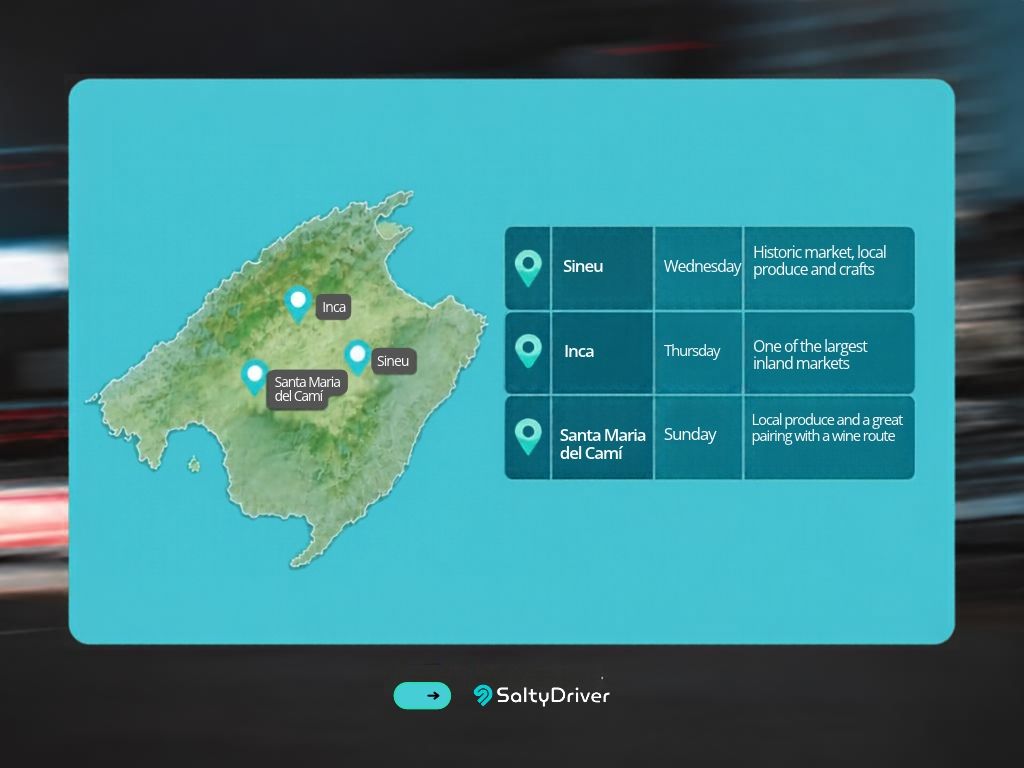
Particularly worth highlighting are the markets of Sineu (Wednesdays), Inca (Thursdays), and Santa María del Camí (Sundays). You’ll find a wonderful array of local goods and products to take a little piece of Mallorca home with you — from artisan crafts to cured meats and traditional sweets.
Our recommendation: extend the visit with a coffee in a nearby village, book a table for lunch, or stop at one of the many hidden corners of this part of the island. If you visit the Sineu market, for example, you might have lunch at one of Petra’s traditional restaurants, or head up to the Santuari de Bonany. Ask your Salty Driver chauffeur for suggestions based on your route.
Autumn Fairs in Mallorca
The traditional fairs that fill many inland villages with life between October and November are another of the great draws of the Mallorcan autumn.
Among the best known: the Fires de Llucmajor, held from late September into October; the Fires d’Inca, culminating in November with the emblematic Dijous Bo; the Fira Dolça de Esporles, dedicated to traditional pastries and artisan sweets; and the Fira de s’Oliva de Caimari, celebrating the olive and olive oil — two products deeply embedded in Mallorca’s landscape and agricultural heritage.
Beyond the specifics of each edition’s programme, these fairs are a wonderful opportunity to encounter a more local Mallorca: stalls filled with artisan products, local food, cultural activities, and village streets that come alive with a special atmosphere for a few precious days.
Salty Driver tip: during fair days it’s common for traffic to be redirected through village centres, with road closures and limited parking. If you’re planning to include one on your route, it’s worth checking the official programme in advance and planning your drop-off or collection point accordingly.
How to Combine Several Experiences in One Day
One of the great advantages of autumn is that you don’t always have to choose just one plan. With a little organisation it’s perfectly possible to string together several nearby experiences without spending half the day on the road. Here are some of our favourite combined routes:
Raiguer Wine Route: Santa María del Camí → Consell → Binissalem.
Perfect for combining a winery visit with lunch and a stroll through one of these villages.
______________________________________________________________
Tramuntana Route: Valldemossa → Deià → Sóller.
A full day combining heritage, landscape, and gastronomy — particularly enjoyable outside the busiest tourist months.
______________________________________________________________
Pla Route: Sineu → Petra → Santuari de Bonany.
On Wednesdays, start at the Sineu market, follow with a traditional lunch in Petra, and finish by taking in the sweeping views of the Pla from Bonany.
______________________________________________________________
Llevant Route: Manacor → Petra → Felanitx.
This route combines heritage, wine, and a climb up to the Santuari de Sant Salvador.
Salty Driver tip: in autumn, we prefer to plan fewer stops and allow more time for each one. The hours of daylight are shorter, and on the secondary roads of the interior or the Tramuntana, distances that look short on the map don’t always translate to short journey times. And since the cyclists are back on Mallorca’s roads in autumn, it’s worth building in a little extra time along the way.
Frequently Asked Questions
Is it worth visiting Mallorca in autumn?
Absolutely. Autumn is a particularly rewarding time for hiking, wine tourism, markets, and exploring the inland villages — with far less tourist pressure than during the peak summer months.
What is there to do in Mallorca in October?
Among the most interesting plans: walking routes through the Serra de Tramuntana, visiting wineries in the Raiguer or Pla i Llevant, discovering the inland markets, and attending the traditional fairs held throughout October.
Do you need a car to get around Mallorca in autumn?
It depends on your itinerary. For routes that connect several villages or end at a different point from where they began, organising transport in advance can be particularly useful. Palma and some other destinations can also be reached by public transport.
Where can I do a winery tour in Mallorca?
The two main areas are the DO Binissalem, in central Mallorca, and the DO Pla i Llevant, spread across municipalities in the centre and east of the island. Many wineries require advance booking.